

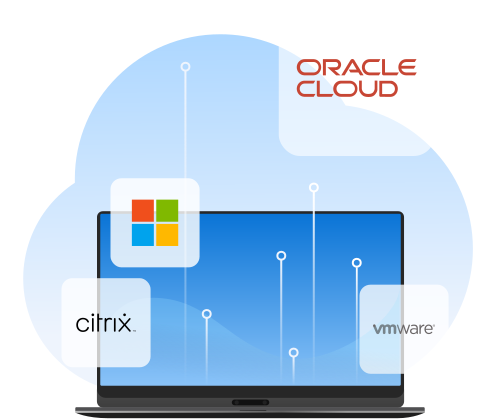
Move Your RDS, Citrix, or VMware VDI to the Cloud Without Rebuilding from Scratch
Thinfinity Cloud Manager lifts your existing Windows server workloads and published apps to OCI or any cloud. No application rewrites. No hypervisor requirement. A phased migration that keeps users online throughout.
Join over 5,000 leading companies that trust Cybele Software






































50–75%
Lower cloud compute cost vs Azure (OCI)
RDS / Citrix / VMware Horizon
All on-premises stacks supported as source
Days, not months
Pilot deployment on OCI from day one
Migrate from any of these
Every on-premises RDS, Citrix, or VMware environment is facing at least one of these forcing functions
These are not distant trends, they are active deadlines, budget decisions, and security incidents happening right now across the enterprise.
Citrix LAS deadline
Citrix sunset file based licensing in April 2026. On-premises deployments not migrated to the cloud based License Activation Service will lose functionality entirely, no grace period, no fallback.
Server hardware reaching end-of-life
VDI server hardware has a 3–5 year refresh cycle. Organizations whose RDS or VDI hosts are aging are forced to decide: buy new on-prem hardware again, or finally migrate to cloud.
Data center lease expiry
Co-location contracts expiring in 2025–2027 are the single biggest trigger for cloud migration. The project that was deferred for years now has a hard deadline attached.
VMware/Broadcom pricing shock
Broadcom's 72-core minimums and 200–1,500% price increases have made on-prem VMware Horizon uneconomical for most mid-market organizations. The hypervisor is now the migration trigger.
Security and patching burden
On-premises RDS and Citrix environments require constant manual patching. Unpatched VDI gateways are among the most frequently exploited attack surfaces, every missed patch is a liability.
Citrix admin talent shortage
Citrix-certified admins are increasingly scarce and expensive. Organizations can no longer staff the specialized expertise required to maintain complex on-premises Citrix environments.
"Migrate to AVD" or "Migrate to Citrix Cloud" both lead to Vendor lock-in, and neither is simple
Migrate RDS Azure AVD
Migrate Citrix Citrix Cloud
Migrate with Thinfinity on OCI
One platform replaces your entire on-premises broker, gateway, and management stack
Citrix on-premises stack
Windows RDS stack
Thinfinity Workspace replaces all of this
Thinfinity Gateway
Reverse proxy: replaces NetScaler ADC + RD Gateway. Outbound-only, no inbound ports.
Cloud Manager
Provisioning, autoscaling, image lifecycle. Replaces Citrix MCS, Provisioning, and manual RDS scripts.
Monitoring & RPAM
Real-time session visibility and recording: replaces Citrix Director and third-party monitoring tools.
VirtualUI (legacy app portal)
Publishes Win32 apps to browser with zero code changes: replaces StoreFront RemoteApp delivery.
Thinfinity Broker
Session brokering and load balancing: replaces DDC and RD Connection Broker.
Identity & access (SSO/MFA)
SAML, OAuth, OIDC, RBAC: replaces Citrix Licensing Server and AD-only RDS access.
OCI costs up to 50–75% less than Azure
before you even add Nerdio
Compute
- D-series standard VMs
- ~$0.19–0.38/vCPU-hour
Oracle pricing is consistent across all regions. Azure charges up to 60% more for São Paulo, Frankfurt, and other non-US regions.
Block Storage
- Managed disk (P-series)
- ~$0.17–0.25/GB/month
OCI block storage offers 1.5× the IOPS of equivalent Azure disks at 81% lower cost for a 500 GB volume.
Data Egress
- ~$0.087/GB after 5 GB free
- 100 TB = ~$8,900/month
For 500 VDI users with moderate session activity, Azure egress can add $5–15 per user monthly. OCI's 10 TB free tier covers most mid-market deployments entirely.
Management costs
Thinfinity concurrent licensing vs. Citrix/RDS named-user or per-device — an organization with 400 users and 60% peak pays for 240 sessions, not 400.
Technical Flexibility
Native OCI KVM. No bare metal, no nesting
Thinfinity runs directly on OCI's native KVM hypervisor. No bare metal instances, no nested virtualization tax. Standard VM shapes (E4 flex, E5, GPU) provision in seconds via Cloud Manager's OCI Compute API integration.
Full cloud orchestration built in
Cloud Manager handles the entire VM lifecycle: golden image deployment, pool provisioning, schedule-based and demand-driven autoscaling, patch orchestration, and deallocation. No external orchestration tools or custom scripts are required.
ZTNA enforced at every session
Every desktop and app session is brokered through Thinfinity's outbound-only ZTNA Gateway. MFA, RBAC, identity context, and session recording apply automatically so that the firewall stays fully closed, with no inbound ports required.
Any device via HTML5 browser or native client
Users connect through a standard browser (HTML5, zero install) or the Thinfinity native client for Windows, macOS, iOS, or Android. The delivery model is chosen per user group based on your security and UX requirements, and both run through the same ZTNA gateway.
Dynamic Scaling and Built in automation
Cloud Manager scales VM pools automatically, spinning up ahead of demand and deallocating idle hosts with no manual intervention. Scheduled policies, demand triggers, and per-pool thresholds are all managed from one console; no PowerShell, no Nerdio, and no external orchestration are required.
Thinfinity secures access and controls infrastructure across every cloud and hypervisor
Most VDI gateways only broker access. Thinfinity Cloud Manager also provisions, autoscales, and manages virtual machines directly on each platform.

Hyper-V
Windows Server

VMware vSphere
vCenter · ESXi

Proxmox VE
KVM - LXC

Nutanix AHV
Acropolis HCI

KVM (OCI)
Native bare metal


Oracle Cloud (OCI)
Best price/performance

Microsoft Azure
Existing tenants

IONOS Cloud
EU Sovereign

AWS
EC2 - Workspaces

On-Premises
Private DC - HCI
No forced hypervisor migration
Provision VMs directly, no vCenter dependency
Burst to cloud during peak demand
Single management plane across all environments
Any identity provider and any workflow, without being locked to Entra ID like AVD.
Thinfinity is identity-agnostic: use the IdP you already have, mix multiple IdPs for different user groups, and change or extend your identity stack at any time without touching your desktop environment.

Okta
SAML 2.0 · OIDC

Ping Identity
PingFederate · PingOne

Google Workspace
OAuth 2.0 · OIDC

Oracle IDCS
OCI Identity · SAML

Any SAML 2.0 IdP
Shibboleth · ADFS · etc.

On-prem Active Directory
Kerberos · LDAP · AD FS

Microsoft Entra ID
SAML · OAuth · OIDC

Any OAuth 2.0 / OIDC
Custom · KeyCloak · Auth0

Local users + MFA
Built-in · TOTP · FIDO2
Why identity flexibility matters
AVD forces Entra ID, Thinfinity does not
Azure Virtual Desktop only authenticates via Microsoft Entra ID (Azure AD). Migrating to AVD means committing your identity layer to Microsoft. Thinfinity integrates with any SAML 2.0, OAuth 2.0, or OIDC-compliant provider.
Different user groups, different IdPs
Identity multi-tenancy means a manufacturing team can authenticate through on-premises AD, contractors through Okta, and C-suite through Ping Identity; all of them accessing Thinfinity from the same portal with separate policies.
Switch or extend your IdP without changing VDI
When your business acquires a company, migrates to a new IdP, or layers an additional authentication layer, Thinfinity simply adds the new federation. Your desktop environment is never the reason you can't change your identity stack.
MFA, RBAC, and conditional access across all IdPs
MFA enforcement, role-based access control, and conditional access policies (location, device posture, time of day) apply regardless of which IdP is in use. Security controls are consistent across all identity providers.
Built for every on-premises workload type
Whether you're running RDS on aging Windows Server hardware, a multi-tier Citrix farm, or a VMware Horizon environment pending a Broadcom exit, Thinfinity provides a migration path to OCI that preserves your apps and users.
Migrating from Windows RDS / Terminal Services
Migrating from Citrix Virtual Apps & Desktops
Migrating from VMware Horizon (Omnissa)
Migrating from Azure AVD to OCI (cloud-to-cloud)
A phased migration that keeps users online throughout, avoiding a big-bang cutover.
Thinfinity deploys alongside your existing RDS or Citrix environment. Users migrate in cohorts so that production never stops. The legacy stack is decommissioned only after the new environment is validated.
Questions IT and architecture teams ask most when planning a cloud migration
Yes. Thinfinity deploys alongside your existing RDS or Citrix environment. Users migrate in cohorts, keeping your legacy stack live until Thinfinity is fully validated. There is no forced cutover. The phased migration typically takes 4–12 weeks depending on environment size, with production continuity throughout.