


VDI for Contractors on Oracle Cloud
Full Windows and Linux desktops for contractors, vendors, and third-party engineers — endpoint agnostic, provisioned on demand as persistent, pooled, or ephemeral.
Join over 5,000 leading companies that trust Cybele Software






































Three integrated modules that deliver contractor VDI end-to-end
Thinfinity Workspace is a complete browser-based VDI platform, not a single feature. It combines three core modules: a secure Reverse Gateway that delivers desktops without exposing them to the internet, a Broker that connects users to the right desktop pool with full RBAC, and Cloud Manager that provisions and scales the desktop fleet on OCI.
Entry point
Thinfinity Gateway
Outbound-only reverse proxy. Streams desktops over HTML5. Zero inbound ports. TLS 1.3 everywhere.
Orchestrator
Thinfinity Broker
Routes each contractor to their assigned desktop pool — persistent, pooled, or single-session — with full RBAC and policy.
Automation
Thinfinity Cloud Manager
Provisions, scales, and retires OCI desktop VMs automatically. Golden images, FSLogix profiles, autoscaling.
Who needs contractor virtual desktops
If your contractors need a full desktop environment (not just a web app) to do their work, Thinfinity Workspace VDI is built for that exact pattern. These are the roles where browser-delivered desktops eliminate shipping laptops, license sprawl, and unmanaged-device risk in one move.
IT contractors & MSPs
Pre-configured admin desktops per engagement, retired at handoff
Software developers & QA
Full dev desktops with IDEs, SDKs, and source-tree access via browser
Vendor & OEM support
Vendor-specific desktops with only their tools and only their targets
Auditors & compliance
Read-only audit desktops with pre-loaded tooling and locked clipboard
Procurement & supply chain
Partner desktops with ERP, sourcing, and logistics clients pre-installed
OT & maintenance engineers
Hardened engineering desktops to reach SCADA/PLCs safely
Outsourced helpdesk staff
Per-tenant desktops for offshore agents, isolated by client
M&A due-diligence teams
Deal-scoped desktops on time-bound persistent profiles
Shipping laptops and licensing legacy VDI for contractors was never going to scale
Most enterprises solve "contractor needs a desktop" in one of two ways: ship a managed corporate laptop, or buy a Citrix/Omnissa seat. Both bleed money and time, and neither was designed for a workforce that turns over every quarter.
Shipped laptops never come back
Procurement, imaging, shipping, customs, and reverse-logistics for a six-week engagement. Hardware that walks. Endpoint licenses that outlive the contract.
Standing seats for fluctuating headcount
Citrix and Omnissa license per named user. You pay for 200 contractor seats every month even when only 30 log in this week.
Manual provisioning, golden-image drift
IT hand-builds desktops per role, then forgets to retire them. Templates fork. Each contractor pool drifts further from a known-good baseline.
Unmanaged BYOD as the alternative
Contractors connect from personal devices over VPN. 46% of compromised credentials in 2025 came from unmanaged endpoints (Verizon DBIR).
No session evidence inside the desktop
Connection logs prove the contractor logged in. They do not prove what was opened, copied, or exfiltrated from inside the desktop session.
Compliance pressure on third-party desktops
HIPAA, PCI-DSS, GDPR, DORA, NIS2 expect demonstrable control over what third parties do inside a desktop — not just that one was launched.
Give contractors a desktop, not a foothold in your network
Contractors work inside an isolated session, not on your network. Nothing lands on their device. Every session is fully audited, scaled on demand, and access ends when the engagement does.
Clientless desktop delivery
Full Windows or Linux desktop in any HTML5 browser. No Receiver, no Horizon Client, no VPN app, no shipped hardware.
Outbound-only Zero Trust
Desktop VMs stay off the public internet entirely. Reverse-proxy architecture means no inbound ports on the desktop fleet.
Just-in-Time desktops
Pooled or ephemeral desktops spun up per session and destroyed at logoff. No persistent profile to compromise, no standing VM to patch.
Full session recording
Every action inside the desktop captured — keystrokes, screen, clipboard, file transfers — as tamper-proof audit evidence.
Contractor desktops on demand, in minutes
Contractor Device
Any browser - Any OS - No install required
Thinfinity Gateway
Outbound-only - TLS 1.3 - HTML5 stream
Broker + IDP. Identity Verification
MFA - SAML - OAuth IdP-federated
Broker + desktop assignment
RBAC · Pool selection · FSLogix attach
Cloud Manager + OCI desktop fleet
Windows · Linux · Persistent · Pooled · Ephemeral
Just-in-time desktops
Spin up a contractor pool in minutes with expiry, allowed app list, clipboard/print policy, and IP scope. Tear it down at engagement end.
Session recording & audit
Every desktop session fully recorded — keystrokes, screen, file transfers, clipboard events. Tamper-proof logs for auditors or IR.
Zero standing desktops
Ephemeral pools mean no VM exists between sessions. Persistent profiles attach at logon and detach at logoff — nothing to compromise at rest.
Every desktop model your contractors need, from a single platform
Cloud ZTNA vendors like Zscaler and Cloudflare cover web apps and SaaS. Your contractors need full desktops — persistent, pooled, ephemeral, or GPU-accelerated — plus the occasional published app or protocol session. Thinfinity handles all of it from one gateway, with every desktop model built in.
Persistent desktops
Dedicated Windows or Linux VMs per contractor. State, installed tools, and profile preserved across sessions.
Pooled desktops
Shared desktop pools with FSLogix profiles. Contractor gets the same experience, but no VM stays bound to them.
Ephemeral desktops
Single-session desktops created at logon, destroyed at logoff. Zero state between sessions. Ideal for high-turnover roles.
GPU-accelerated desktops
NVIDIA-equipped OCI shapes for CAD, 3D, ML, and media contractors. Same browser delivery, full GPU acceleration.
Published apps & web
Publish individual Win32 apps or internal web portals when a full desktop is overkill. Same gateway, same audit.
RDP · SSH · VNC
Admin and engineering access to servers, OT systems, and appliances when the contractor's work happens at the protocol layer.
VPN vs. cloud ZTNA vs. Thinfinity Workspace, for contractor VDI
Legacy VPN + Citrix/Omnissa
Cloud ZTNA (Zscaler / Cloudflare)
Thinfinity Workspace on OCI
The same VDI platform, tuned for every third-party desktop scenario
Thinfinity's contractor VDI model adapts to enterprise IT, regulated industries, OT environments, and managed service providers — all from a single, centralized policy engine and one OCI desktop fleet.
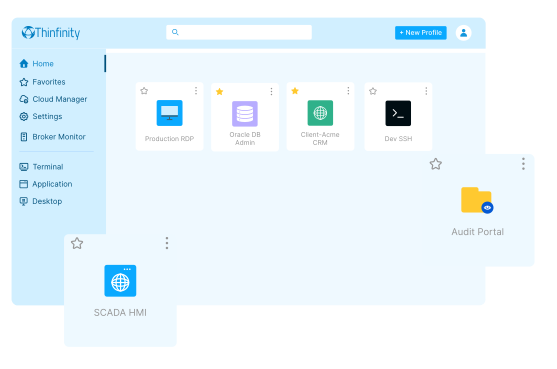
MSPs & IT outsourcers
MSP engineers get per-client admin desktops on demand. White-label portal, ephemeral pools, full session recording for SLA evidence.
OT & manufacturing
OEM engineers receive hardened engineering desktops to reach SCADA/PLCs. Isolated VM per vendor, JIT windows, full screen capture.
Financial services
Auditors and seasonal compliance staff land on locked-down desktops with core banking and trading clients pre-installed. GLBA/FFIEC-grade audit.
Healthcare
HIPAA-compliant desktops for billing partners, medical coders, and locum clinicians. EHR-level granular controls, no PHI on contractor devices.
Legal & professional services
E-discovery vendors and outside counsel get matter-scoped desktops with review tools pre-loaded. Auto-revoke at matter close.
DevOps outsourcing
External developers get full dev desktops with IDEs, SDKs, and source-tree mounts. Lateral movement architecturally impossible.
Stop paying enterprise premiums for contractor desktops you don't actually use
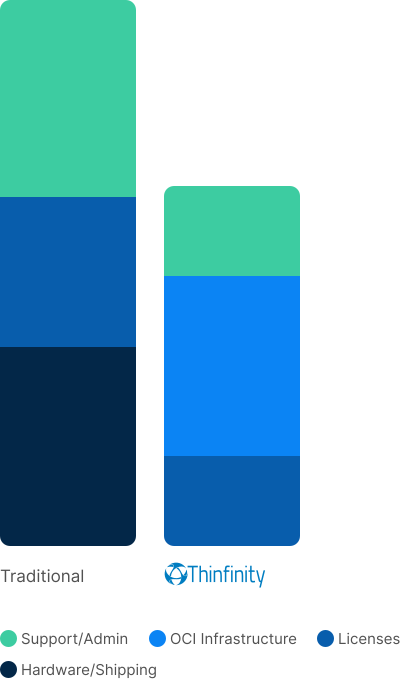
Three line items quietly compound on every contractor desktop stack: standing per-user licenses for contractors who log in twice a month, shipped corporate laptops with procurement and reverse-logistics overhead, and legacy VDI infrastructure with its own patching burden. Thinfinity Workspace on Oracle Cloud collapses all three into a single browser-based platform, licensed by concurrent user, priced on OCI's class-leading infrastructure economics.
contractor VDI TCO reduction in year one with Thinfinity on OCI
time-to-productive desktop for a new contractor
OCI price-performance advantage vs AWS/Azure
Cost composition, per 1,000 contractor seats
Illustrative. Verify with your internal TCO model.
Thinfinity Workspace maps directly to the controls your auditors actually test
Contractor access workflows in Thinfinity align with enterprise compliance frameworks. Every session evidence requirement is satisfied by the built-in Session Recording and Audit capabilities.
SOC 2
Gateway access control, JIT scoping, audit log review
HIPAA
Business-associate access to PHI with full session recording
PCI-DSS
Scoped CDE desktops with session-level audit evidence
GLBA
Third-party service-provider oversight for FFIEC review
GDPR
Data-processor access with consent and purpose-limit controls
ISO 27001
A.9 Access Control and A.15 Supplier Relationships
NIS2
Third-party and supply-chain risk controls
FedRAMP
Via OCI Government Cloud and dedicated-region deployments
Thinfinity Workspace, proven at enterprise scale

Thinfinity Workspace on Oracle Cloud let us retire shipped contractor laptops, cut our named-user VDI license bill dramatically, and give auditors a single audit log for every third-party desktop session. We went from multi-day onboarding to under an hour, with zero standing privilege and full session evidence on every engagement.
Enterprise customer reference
Head of Digital Workplace · Fortune 500 aviation
1,500+
contractor desktops migrated to Thinfinity on OCI in one quarter
-62%
annual contractor VDI licensing spend reduction
8 hrs
mean time from contract sign to first productive desktop
Questions we hear most from security and IT teams adopting contractor VDI
Citrix and Omnissa license per named user — you pay every month whether the contractor logs in or not. Thinfinity licenses by concurrent active sessions, so 200 contractors with 30 peak concurrent = 30 licenses. Provisioning is also faster: Cloud Manager spins pooled or ephemeral OCI desktops in minutes, no broker farm to maintain.